Why We Still Reach for Laravel in 2026
Framework fashion moves quickly, but the reasons we keep choosing Laravel for client work have barely changed — and the ones that have, changed in its favour.
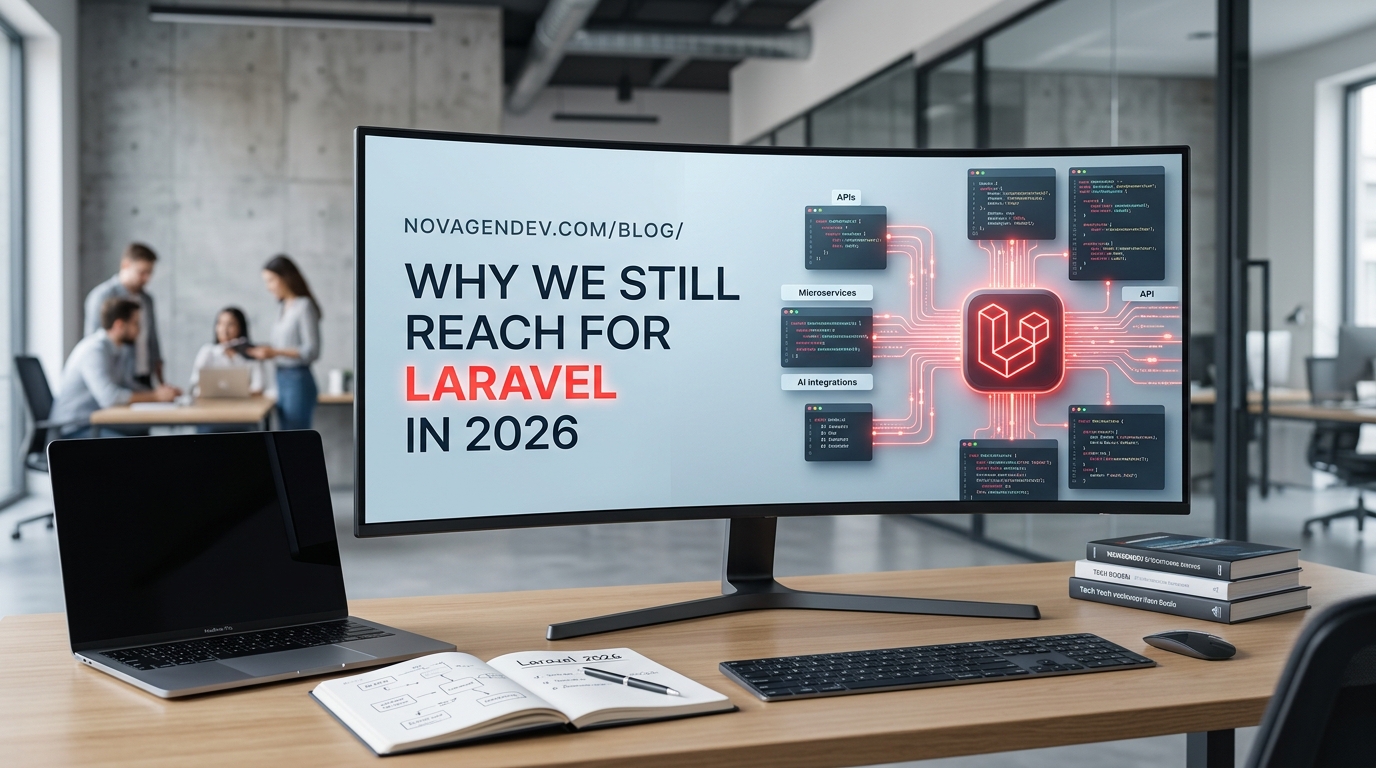
Every year someone declares PHP finished, and every year we ship another platform on Laravel that a client will still be running profitably in a decade. That is not stubbornness. It is a fairly cold calculation about what actually determines whether a software project succeeds.
The boring parts are already solved
A typical business platform needs authentication, authorisation, queued jobs, scheduled tasks, database migrations, file storage, mail, caching and a testing story. Laravel ships all of it, designed together, documented in one place. The alternative is assembling nine libraries with nine opinions and maintaining the seams yourself.
That matters most eighteen months in, when the developer who made those choices has moved on and someone new has to understand the system. Convention is a gift to your future team.
The most expensive line of code is the one nobody understands well enough to change.
Performance stopped being the argument
PHP 8.3 with JIT, opcache and preloading is genuinely fast. Paired with Octane, a well-built Laravel API comfortably handles the load profile of the overwhelming majority of business applications. We have benchmarked it against Node and Go services on identical workloads for client decisions, and for CRUD-heavy line-of-business software the difference is rarely what limits you. Database query design almost always matters more than runtime choice.
Where we do not use it
We are not zealots. Real-time collaborative editing, high-frequency socket work and heavy stream processing go to Node or Go. Mobile goes to Flutter. Laravel is the default for the business core, not a universal answer, and the honest version of this argument has to include the cases where something else wins.
The hiring reality in Sri Lanka
There is a deep local pool of capable PHP and Laravel engineers. When a client eventually brings development in-house — and good clients often should — we want to hand over a codebase they can actually staff. Choosing an exotic stack can quietly lock a business into depending on the agency that built it, and we would rather earn a renewal than engineer one.
Tagged
Working on something like this?
We are happy to talk through a technical decision even when it does not turn into a project. NovaGen is based in Minuwangoda, Sri Lanka and works with clients worldwide.